
AMC · NGS
AMC in Blood - Advanced Metagenomic Analysis
Advanced clinical analysis using metagenomic nanopore sequencing to detect viral, bacterial and other microorganism infections present in venous blood
Request information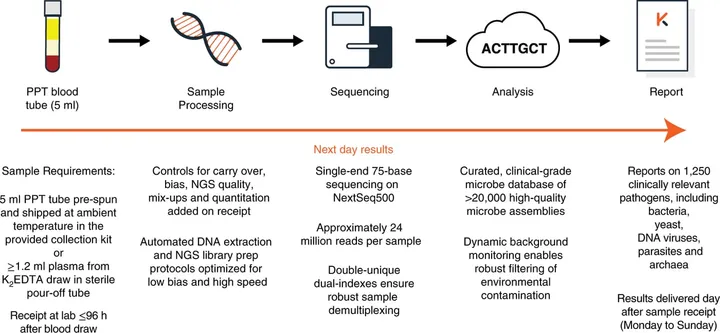
- Metagenomic nanopore sequencing
- Detection of viral and bacterial infections
- Venous blood analysis
Description
What is AMC in Blood?
AMC in blood (AMCS) is an advanced clinical analysis performed using metagenomic nanopore sequencing, designed to detect viral, bacterial and other microorganism infections present in venous blood.
It uses third-generation sequencing (NGS) techniques to comprehensively identify all microorganisms and resistance and virulence plasmids present in the sample.
Technical specifications
| Parameter | Value |
|---|---|
| Sensitivity | > 99.55% |
| Specificity | > 99.55% |
| Minimum depth | 30X |
| PCR amplification | Not required |
| Technology | 3rd-generation NGS |
| Read length | > 4 Mb |
Key features
- High quality and precision in genomic sequencing
- Read length greater than 4 Mb
- Easy reassembly of microbial genomes
- Lower error rate
Technology
Nanopore sequencing
We use third-generation nanopore technology that enables long reads (> 4 Mb) for a comprehensive analysis of all microorganisms present in the blood sample.
- Reads longer than 4 megabases
- Complete reassembly of microbial genomes
- Identification of resistance plasmids
- Detection of virulence genes
No PCR amplification
Our protocol does not require PCR amplification, eliminating biases and artifacts that can interfere with the accurate detection of microorganisms.
- Elimination of amplification biases
- Reduction of technical artifacts
- Higher sequencing fidelity
- Detection of minority variants
High precision and sensitivity
We achieve a sensitivity and specificity greater than 99.55% with a minimum depth of 30X, guaranteeing the reliable detection of pathogenic microorganisms.
- Sensitivity > 99.55%
- Specificity > 99.55%
- Coverage depth 30X
- Lower error rate
Workflow
- DNA extraction — Direct extraction of microbial DNA from the blood sample.
- Library preparation — Preparation without PCR amplification to avoid biases.
- NGS sequencing — Third-generation nanopore sequencing.
- Bioinformatic analysis — Identification of microorganisms and resistances.
- Clinical report — Detailed report with therapeutic recommendations.
Sample
Sample collection protocol
| Requirement | Detail |
|---|---|
| Sample type | Venous blood (primary sample) |
| Volume | 5-10 ml |
| Anticoagulant | EDTA (purple tube) |
Transport conditions
| Condition | Requirement |
|---|---|
| Temperature | 2-8 °C (refrigerated) |
| Maximum time | 48 hours |
| Container | Specific packaging for transport |
| Labeling | Clear patient identification |
Important considerations
- Draw before starting antibiotic therapy (if possible)
- Aseptic technique to avoid contamination
- Correct patient identification
- Cold storage until processing
- Avoid freezing the sample
Required clinical information
- Patient demographic data
- Current clinical symptoms
- Prior antimicrobial treatments
- Diagnostic suspicion
- Clinical context (ICU, transplant, etc.)
Results
Microorganism detection
| Group | Detection scope |
|---|---|
| Bacteria | Pathogenic and commensal species |
| Viruses | Detection of viral DNA and RNA |
| Fungi | Yeasts and filamentous fungi |
| Parasites | Protozoa and other pathogens |
| Mycobacteria | M. tuberculosis and atypical mycobacteria |
Antimicrobial resistance
| Element | Description |
|---|---|
| Resistance plasmids | Mobile genetic elements |
| Resistance genes | Specific mechanisms |
| Virulence factors | Pathogenicity genes |
| Phenotypic prediction | Antimicrobial susceptibility |
Results turnaround time
| Phase | Timing |
|---|---|
| Receipt | Day 0 — Arrival of the sample at the laboratory |
| Processing | Days 1-10 — Sequencing and analysis |
| Report | Day 12 — Delivery of the clinical report |
Clinical recommendations
- Correlation with the patient’s clinical presentation is essential
- Consider possible contamination in cases of gram-positive cocci
- Absence of detection does not rule out infection
- Results should be interpreted in clinical context
- Consult a clinical microbiology specialist if necessary
Clinical indications
Priority indications
- Sepsis and septic shock — Rapid diagnosis in critically ill patients.
- Bacteremia in immunocompromised patients — Transplant, oncology, HIV.
- Nosocomial infections — Suspected multidrug resistance.
- Fever of unknown origin — When conventional methods fail.
Secondary indications
- Infective endocarditis
- Vascular prosthesis infections
- Meningitis of unknown etiology
- Chronic osteomyelitis
- Intravascular catheter infections
Specialties that request it
Critical Care Medicine · Cardiology · Clinical Infectious Diseases · Oncology · Pulmonology · Nephrology · Surgery · Pediatrics
Advantages of AMC in Blood
- Broad detection of microorganisms
- Identification of resistances
- Does not require prior culture
- Higher sensitivity than cultures
- Results in 15 days